Showing posts with label acedia. Show all posts

Tuesday, February 4, 2025

Weltschmerz

 In prepping for class--reading and taking notes on a friend's essay I've assigned--I ran into a fun word: Weltschmerz. From the German words for world and pain, the term means (in the quick-searched dictionary.com's phrase) "sorrow that one feels and accepts as one's necessary portion in life; sentimental pessimism."

I had vaguely associated the term with German Romanticism (Sorrows of Young Werther sort of stuff). Wikipedia specifies that it's from Jean Paul (a German Romantic), who in turn takes it from a work by the Brothers Grimm (!) to describe "tiefe Traurigkeit über die Unzulänglichkeit der Welt" ("deep sadness about the inadequacy of the world").

How to say: I love this word. "World-weariness"--a resignation that the world is not and will never be "good." 

I'm struck, on the one hand, at how well it captures the worldview of my spirit animal: Eeyore. (My sister insists that my spirit animal is the octopus, which I love! But so often my spirit seems shaped like a depressed stuffed donkey.)
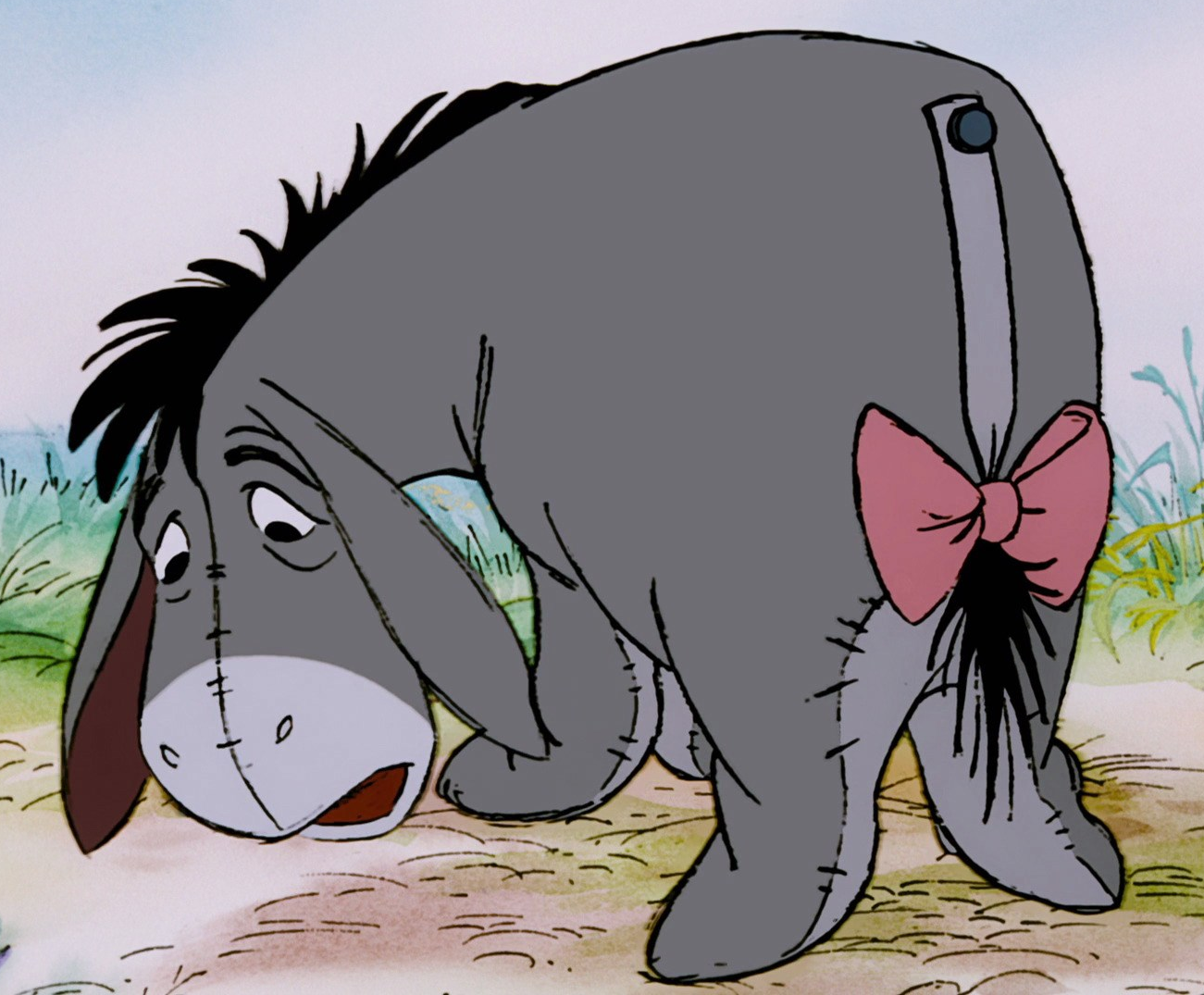


Weirdly, the idea also seems to resonate with (my inadequate understanding of) certain Buddhist precepts. Life is suffering. Suffering comes from desire/attachment. Letting of of that attachment is a way through. 

Weltschmerz, though, doesn't let go of attachment. It steeps simply misses it, saturating in suffering for what cannot be. It's melancholy without the process of mourning. 

And as such, it becomes--like Eeyore--slightly pitiable and silly. "Sentimental pessimism" is such a cool phrase. (Good job, dictionary-dot-com!) It takes something that could be profound and deep--there are modes of deep pessimism, I think--and empties it of profundity, making it a pose or an attitude. The stereotype of goth teens (or, later, emo teens) likewise seems a species of "sentimental pessimism." Of course, teens of every generation often do suffer from serious depression, so the stereotype itself lacks some generosity and understanding.

BUT--there are plenty of times when I feel the need to give myself a kick in the behind, to jolt myself out of the swamps of Weltschmerz into . . . well, something more helpful or active. 

There's a dangerous pull for me in Weltschmerz, something akin to the sin of acedia--often rendered sloth but perhaps better a kind of conscious freeze after overwhelm, a protective posture of exhausted cynicism. 

What's the line between pessimism and cynicism, I wonder? I like the description I heard of cynicism as "low hope, low humility"--absolutely certain, certain to the point of arrogance, that there is no hope. Exhaustion, by contrast, is "low hope, high humility." Perhaps that's pessimism as well. Maybe Weltschmerz is "low hope, high visibility."

Sunday, December 8, 2019

Wrath versus Sloth

In my more pessimistic moments, I think our immediate political future in this country boils down to a war between vices. Which will prove stronger: wrath or sloth?

Right now wrath feels like it's winning. I was talking to my partner today about Joe Biden's recent angry challenge to a voter in Iowa. The voter, an unnamed 83-year-old farmer, said Biden's son Hunter had been up to no good in Ukraine. Biden called the man a "damn liar." The heated exchange continued, with the farmer claiming Biden was too old to run. Biden responded by challenging the man to a push-up contest and an IQ test.

My partner thought this was a good look for Biden. Biden has to beat a bully, he reasoned, so he has to become more bullish.

House Speaker Nancy Pelosi likewise had a testy exchange with a reporter from Sinclair news asking if she hated the President. She forcefully refuted that thought, attesting that she prays for the President every night. She had no patience, she said, for the insinuation that she operates from animosity. "Don't mess with me," she told the reporter.

This, too, my partner says, is a good step for Democrats. "It's time Democrats stopped being the nice pushovers."

"No Republican," I responded, "not a single one that I read, believes that Democrats are too nice." Quite the opposite. The rude, judgmental liberal is a staple of media discourse on the right. Indeed, if you hid the names and affiliations of players in most political news stories, folk on the right and the left would likely automatically attribute tales of rude remarks or angry outbursts to the other side. Both sides, at least online enclaves, seem certain that the other team operates in bad faith. Each loathes the other.

Beneath this wrath lies quite a lot of fear and no small amount of despair. It's gospel in most parts of the online right that a President Hillary Clinton would have ended the Republic, declaring martial law and extending her totalitarian powers into a permanent police state. Obviously progressives think we're seeing the start of just such a devolution in the Trump presidency.

I used to worry, in my naivete pre-November 2016, about what Trump's base of support would do the day after he loses the election. Would Trump respect the results? Would he cede the election? Would his followers declare civil war? Now I wonder about whether some on my own side won't panic in similar ways should Trump be re-elected in 2020 (I consider this a likely outcome).

The specter of civil war sometimes doesn't seem that far away.

But the kryptonite of wrath is sloth. Inertia, to paraphrase Rick James, is a hell of a drug. Aside from being an awful humanitarian catastrophe, civil war is just so energy intensive. It takes so much work. The pacification measures laced into our lifestyles and media are quite powerful. Barely half the eligible populace even votes. Of course, such widespread lassitude can make coups d'état much easier to accomplish. But even that level of effort and organization seems unlikely in the USA absent some significant changes.

It bears remembering, though, that sloth isn't necessarily better than wrath. Sloth, after all, doesn't mean laziness. The old term acedia names more a kind of depressed inaction brought about by a lack of hope. It's more like despondency. It is the sin that, alongside pride, I am most vulnerable to. It describes my personal gravitational pull away from God.

I hardly want civil war or fear-based rage to rule the day. But a hopeless, despondent inaction, a suicide without death, is surely not much better.